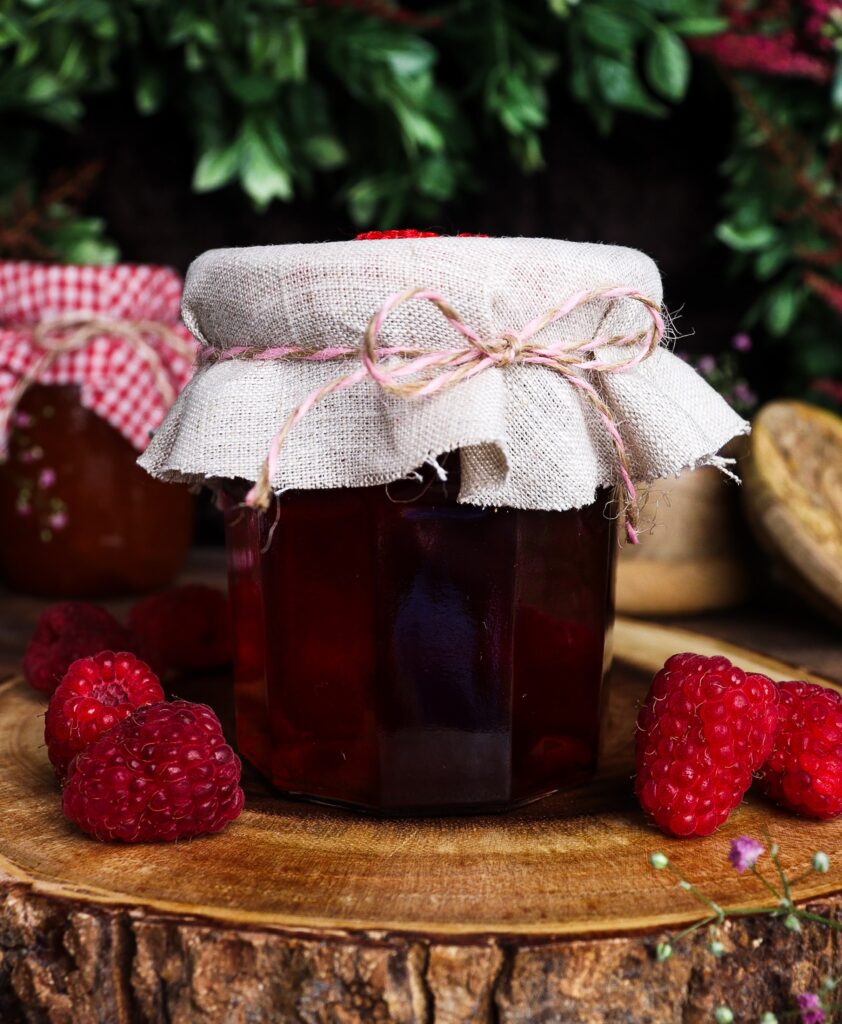
From a sunny garden patch of the Shire, fresh produce has been gathered for this raspberry lavender jelly which will be stored away in a well-stocked hobbit pantry!

A Hobbit's Pantry
Through the long, hot summer months, the hobbits of the Shire are busy tending their gardens, harvesting their crops, and preserving fresh seasonal produce in their well-stocked pantries. In a hobbit’s pantry you will find summer’s bounty captured in rows of pretty jars filled with berry preserves and fruit jams, bundles of dried herbs, crocks of tangy pickles and savoury chutneys. A hobbit’s pantry embodies their deep love of growing things and the wisdom of preserving the abundant crops of summer for the leaner days ahead.
More Hobbit Pantry items
- Garlic Scape Butter
- Spiced Rhubarb Jam
- Wild Mushroom Seasoning Salt
- Pickled Mustard Seeds
- Spiced Apple Butter
Preserves
Preserve the fruits of summer in a sweet, floral jelly, created from the warmth of the season and carried into the chill of autumn. Delicate lavender blossoms add subtle floral notes to this sweet raspberry jelly. This crystal clear, jewel-toned jelly perfectly captures the ripe berries of summer and is delicious spooned onto a scone or buttered toast – the flavours work well with our hobbit Seed Scones. Come fall, nestled in your warm hobbit hole while the weather grows cold outside, pulling out a jar of this lavender-scented jelly will be a welcome reminder of summer's bounty.

Ingredients
Raspberries: The raspberry juice can be collected either by using a steam juice extractor or by hanging the fruit in a jelly bag. To hang the fruit, warm the raspberries in a large pot with a few tablespoons of water just until the berries begin to break down. Mash the berries well and then add to a jelly bag. Hang the bag over a bowl and allow the juice to drip from the fruit. This could take up to overnight. Do not squeeze the bag which could result in a cloudy jelly.
Lavender: You can use dried or fresh lavender buds for this recipe. Add them to either a disposable tea bag or a cheesecloth sachet.
Pectin: I used the powdered pectin, Certo, to set this jelly.
Sugar: I recommend using granulated sugar to make this jelly.
Canning jars: I like using half pint jars for making jelly. Make sure that the canning lids are brand new and haven’t been used before.
How to Make Raspberry Lavender Jelly
Prep the raspberry juice
To get the raspberry juice, you will need to either use a juice steamer or a jelly bag. To use a juice steamer, follow the operating instructions. To use a jelly bag, begin by adding the raspberries to a large pot. Add a couple tablespoons of water and place over medium heat. Heat the raspberries just until the begin to break down. Remove from the heat and then mash the berries.
Transfer the berries to a jelly bag and hang above a large mixing bowl. I like to tie the bag to a cupboard knob over a mixing bowl on the counter. Allow the berries to drain up to overnight until all of the juice is drained. Discard the pulp.
Prep the canning equipment
The first step in making jelly is to gather your equipment and sterilize the jars. I typically do not water bath when making jelly so it is imperative that both the jars and jelly are hot when canning.
Preheat the oven to 250°F. Make sure the jars are clean and then place on a baking sheet in the oven for at least 15 minutes before canning. Add the canning lids to a small saucepan with water and place over low heat in barely simmering water. Keep clean tongs and a towel nearby. Gather together a clean ladle, funnel, and damp cloth and have ready to go. Have a potholder ready for the hot pot.
Cook the jelly
When the canning equipment is all sterilized and ready to go, begin to cook the jelly. Add the lavender to a tea bag or cheesecloth sachet.
Add the raspberry juice to a large pot along with the lavender tea bag. Stir in the pectin and then bring to a boil over medium high heat, stirring constantly. When the juice comes to a full, rolling boil, add the sugar all at once. Stir until the sugar is dissolved, skimming occasionally as needed.
Bring the jelly mixture back up to a boil and cook for 1 minute. Remove from the heat and then remove the lavender tea bag. Quickly skim the jelly one last time.
Can the jelly
Immediately transfer the pot to the pot holder. Use tongs to remove a jar from the oven. Use the funnel and ladle to fill the jar with the hot jelly, leaving a half inch space from the top.
Use the damp cloth to wipe the rim of the jar to clean any spills. Use the tongs to remove one of the canning lids from the hot water and wipe dry with the clean towel. Place the lid on the jar and then add the screw top. Hold the jar with a towel and screw the lid on as tightly as possible. Set the jar aside being sure not to press down on the top of the lid – this could give the false impression that the jar has sealed when it hasn’t. Repeat with the remaining jam.
Serve the Raspberry Lavender Jelly
Check the jelly jars after an hour or two to see if they have sealed. A properly sealed jelly jar will make a small popping sound as the lid seals and the top will go from looking rounded to indented. Any jelly that hasn’t sealed can be stored in the fridge and used within a few weeks. Sealed jelly can be labelled and stored in the pantry for at least a year. When opening the jelly, check that it is still sealed and for any signs of mold or spoiling. Discard if you notice any spoilage. Enjoy!