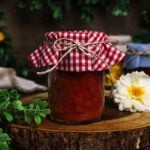
Rhubarb Shallot Relish
This sweet and tangy rhubarb shallot relish is a perfect way to preserve the first flavours of spring in true hobbit style!
Servings: 4 pints
Calories: 39kcal
Ingredients
- 6 cups rhubarb diced
- 2 cups shallots finely diced
- 2 ½ cups granulated sugar
- 1 cup apple cider vinegar
- 1 ½ teaspoon kosher salt
- ½ teaspoon ground cinnamon
- ½ teaspoon ground allspice
- ½ teaspoon ground ginger
- ¼ teaspoon ground cloves
Instructions
- The first step in making preserves is to gather your equipment and sterilize the jars. Fill a water bath canner half way with water. Remove the rack and set aside. Place the canner over medium high heat and bring to a simmer. Fill a kettle with water and bring to a boil – you may need more hot water to add to the canner once you've added the jars.
- Preheat the oven to 250°F. Make sure the jars are clean. Then place the jars on a baking sheet in the oven for at least 15 to 20 minutes. Add the canning snap lids to a small saucepan with water and place over low heat in barely simmering water. Gather together clean tea towels, both a damp and dry cloth, a ladle, tongs, funnel, and thermometer and have ready to go. Have a potholder ready for the hot pot. If using, gather your jar lifter and magnetic lid lifter.
- Wash and chop the rhubarb into a small dice. Peel and finely dice the shallots. Transfer the rhubarb and shallots to a large pot. Add the sugar, apple cider vinegar, kosher salt, and spices.
- Place the pot over medium high heat and bring to a boil, stirring constantly. Maintain the boil and skim periodically to remove any excess foam. The relish will be fairly runny at this point but should thicken over time.
- Continue to boil the relish, stirring constantly until it reaches a temperature of 212°F and has thickened to a sauce consistency. This will take from 15 to 20 minutes.
- Transfer the pot to the potholder on the counter. Use tongs to remove a jar from the oven and place on a tea towel. Use the funnel and ladle to fill the jar with the hot relish, leaving a half inch space from the top.
- Use the damp cloth to wipe the rim of the jar to clean any spills. Use the magnetic lid lifter to remove one of the snap lids from the hot water and wipe dry with a clean tea towel. Place the snap lid on the jar. Hold the jar with the dry cloth and firmly screw on the lid ring. Set the jar aside, being sure not to press down on the top of the lid – this could give the false impression that the jar has sealed when it hasn’t. Repeat with the remaining relish.
- Arrange the sealed jars on the canner rack. Gently lower the rack into the canner, dipping it a few times in the hot water to temper the jars before lowering the rack completely into the canner. Make sure the water completely covers the jars by at least an inch or two. Add more boiling water from the kettle if needed. Cover the canner and bring to a rolling boil. Once the water comes to a full boil, begin the timer for 10 minutes.
- After 10 minutes, carefully lift the rack out of the water and hook over the edge of the canner. Use a jar lifter to remove the jars. Carefully tip any water off the lids, making sure not to press down on the lids and create a false seal if they haven't sealed during the water bath. The jars should seal within a few hours after the water bath.
- A properly sealed jar will make a small popping sound as the lid seals and the top will go from looking rounded to indented. Any jar that hasn’t sealed can be stored in the fridge and used within a few weeks. Sealed jars can be labelled and stored in the pantry for at least a year. When opening the jar, check that it is still sealed and for any signs of mold or spoiling, discarding if you notice any spoilage. Enjoy!
Notes
When home canning it is important that all the equipment and jars are clean and sterilized to prevent contamination.
The relish should be canned while hot immediately after removing from the heat. Ensuring the relish maintains a hot temperature throughout the canning process will ensure the jars properly seal and prevent spoilage.
Properly sealed jars will keep for at least 1 year in a cool, dark pantry. Always check for signs of spoilage when opening your home canned goods.
Nutrition
Serving: 2tablespoon | Calories: 39kcal | Carbohydrates: 10g | Protein: 0.3g | Fat: 0.1g | Saturated Fat: 0.01g | Polyunsaturated Fat: 0.02g | Monounsaturated Fat: 0.01g | Sodium: 56mg | Potassium: 61mg | Fiber: 0.5g | Sugar: 9g | Vitamin A: 12IU | Vitamin C: 2mg | Calcium: 13mg | Iron: 0.1mg
