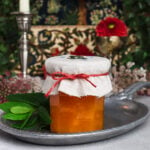
Peach and Bay Leaf Jam
This sweet and herbaceous peach and bay leaf jam is a perfect way to preserve the ripened peaches of summer from the flowering orchards of Gondor.
Servings: 6 pints
Calories: 26kcal
Ingredients
- 2 ¾ lb peeled and diced peaches from about 3 lb (7 or 8 peaches)
- 2 ½ lb granulated sugar
- 4 tablespoon lemon juice divided
- 10 - 12 fresh bay leaves
- 1 teaspoon butter optional*
Instructions
- To peel the peaches, place a large pot of water on the stove over high heat and bring to a boil. Prepare an ice water bath by filling a large bowl with ice and keep ready. Using a slotted spoon, lower 3 or 4 peaches into the boiling water.
- Allow the peaches to boil for about 3 to 5 minutes until the skins begin to loosen. You can tell if they have loosened by lifting a peach out and using your fingers to pinch the skin. If the skin begins pull away then the peaches are done. Alternatively, as soon as you see the skin split, remove the peaches from the boiling water. Immediately plunge the peaches into the ice water bath. Repeat with the remaining peaches.
- Once the peaches are cool, remove them from the water bath. Use a paring knife to loosen the skins and then peel the peaches. Cut the peaches into wedges and then into a small dice. To prevent them from browning, them with 2 tablespoon of the lemon juice once you're halfway through dicing them. Transfer the diced peaches to a large pot. Add the sugar and stir together. Set the peaches aside to soften in the sugar while you prepare the canning equipment.
- Fill a water bath canner halfway with water. Remove the rack and set aside. Place the canner over medium high heat and bring to a simmer. Fill a kettle with water and bring to a boil – you may need more hot water to add to the canner once you've added the jars.
- Preheat the oven to 250°F. Make sure the jars are clean. Then place the jars on a baking sheet in the oven for at least 15 to 20 minutes. Add the canning lids to a small saucepan with water and place over low heat in barely simmering water. Gather together clean tea towels, both a damp and dry cloth, a ladle, tongs, funnel, and thermometer and have ready to go. Have a potholder ready for the hot pot. If using, gather your jar lifter and magnetic lid lifter.
- Once you're ready to cook the jam, use a masher to break down the peaches. If they don't break down easily then you can use an immersion blender later as the peaches cook.
- Place the pot over medium high heat and add the fresh bay leaves and remaining lemon juice. Optionally, add a teaspoon of butter to help prevent the jam from foaming. Bring to a boil, stirring constantly. Maintain the boil, adjusting the temperature to prevent the jam from boiling over. Skim periodically to remove any excess foam.
- If the peach pieces don't continue to break down, you can lower the temperature briefly, remove the bay leaves, and use an immersion blender, or carefully use a masher. Return the bay leaves after blending. It's ok to leave some pieces whole but about half the pieces should be broken down.
- Bring the jam back to a boil and continue cooking. Continue to boil the jam, stirring constantly until it reaches a temperature of 218°F and has thickened. This will take from 15 to 20 minutes total. Remove the bay leaves.
- Transfer the pot to the potholder on the counter. Use tongs to remove a jar from the oven and place on a tea towel. Use the funnel and ladle to fill the jar with the hot jam, leaving a half inch space from the top.
- Use the damp cloth to wipe the rim of the jar to clean any spills. Use the magnetic lid lifter to remove one of the snap lids from the hot water and wipe dry with a clean tea towel. Place the snap lid on the jar. Hold the jar with the dry cloth and firmly screw on the ring lid. Repeat with the remaining jam.
- Arrange the sealed jars on the canner rack. Gently lower the rack into the canner, dipping it a few times in the hot water to temper the jars before lowering the rack completely into the canner. Make sure the water completely covers the jars by at least an inch or two. Add more boiling water from the kettle if needed. Cover the canner and bring to a rolling boil. Once the water comes to a full boil, set the timer for 10 minutes.
- After 10 minutes, carefully lift the rack out of the water and hook over the edge of the canner. Use a jar lifter to remove the jars. Carefully blot any water off the lids with paper towel, making sure not to press down on the lids and create a false seal if they haven't sealed during the water bath. The jars should seal within a few minutes after the water bath.
- A properly sealed jar will make a small popping sound as the lid seals, and the top will go from looking rounded to indented. Any jar that hasn’t sealed can be stored in the fridge and used within a few weeks. Sealed jars can be labelled and stored in the pantry for at least a year. When opening the jar, check that it is still sealed and for any signs of mold or spoiling, discarding if you notice any spoilage. Enjoy!
Notes
*The butter is added at the beginning to reduce the amount of foam in the jam. There will be some foam initially but then it will dissipate and you won't need to skim it too often. It is entirely optional, there just might be more foam generated during cooking that will need to be skimmed.
Nutrition
Serving: 1tablespoon | Calories: 26kcal | Carbohydrates: 7g | Protein: 0.1g | Fat: 0.1g | Saturated Fat: 0.01g | Polyunsaturated Fat: 0.01g | Monounsaturated Fat: 0.01g | Trans Fat: 0.001g | Cholesterol: 0.1mg | Sodium: 1mg | Potassium: 8mg | Fiber: 0.1g | Sugar: 6g | Vitamin A: 22IU | Vitamin C: 0.4mg | Calcium: 0.4mg | Iron: 0.03mg
