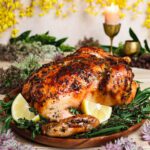
Honey Lavender Roast Chicken
This elegant honey lavender roast chicken is the perfect centrepiece for a Lothlórien-inspired feast or an immersive Lord of the Rings dinner party menu.
Servings: 4 servings
Calories: 710kcal
Ingredients
- 3 - 4 lb whole chicken
- kosher salt as needed
- 8 tbsp butter softened
- 1 tbsp lavender buds
- 2 tbsp chopped fresh thyme
- 1 lemon
- pepper as needed
- 1 onion
- 4 whole garlic cloves
- 6 - 8 sprigs fresh thyme
- 2 tbsp olive oil
- 1 tbsp honey
- ¼ cup all-purpose flour
- ½ cup mead *see note
- 2 cups chicken broth plus extra as needed
Instructions
- It is recommended to salt the chicken overnight. Pat the chicken dry and remove any strings. Liberally sprinkle kosher salt all over the surface of the chicken, even on the back. Place the chicken on a plate and cover. Refrigerate overnight.
- Remove the chicken from the fridge two hours before you intend to roast it. Remove any covering and pat the chicken dry. Allow to come up to room temperature uncovered to allow the skin to dry off.
- While the chicken is air drying you can prepare the compound butter. In a small bowl combine the softened butter, lavender buds, chopped fresh thyme, zest of 1 lemon, 1 tsp kosher salt, and 1/4 tsp pepper. Mix well. Remove 2 tablespoons of the butter and set aside for later.
- Cut a thick slice from the onion and set aside for later; cut the remaining onion into slices. Drizzle a large roasting pan with 2 tablespoons olive oil. Scatter in the sliced onion, garlic cloves, and 4-6 sprigs of fresh thyme. Place a rack on top of the aromatics.
- Preheat the oven to 400°F. Transfer the chicken to the roasting pan. Cut the lemon in half and reserve one half to use in the glaze later. Stuff the cavity with the reserved piece of onion and half a lemon along with 2-3 thyme sprigs.
- Use your fingers to separate the skin from the breast. Rub some of the butter under the skin over each breast. Use twine to tie the legs together tightly and tuck the wing tips under the chicken. Rub the remaining butter evenly over the whole chicken.
- Roast the chicken for 1 hour 15 minutes to 1 hour 45 minutes depending on the size. Baste the chicken regularly with the pan drippings as it roasts.
- While the chicken is roasting, prepare the glaze. Melt the reserved compound butter in a small saucepan. Add the honey, 1/2 tsp kosher salt, and the juice from the remaining half lemon. Whisk to combine.
- Begin glazing the chicken when it reaches an internal temperature around 155°F. Brush the chicken generously with the glaze and continue roasting. Repeat once or twice to use all the glaze. If the chicken turns too dark before it's done, cover with a piece of foil.
- The chicken is done when it reaches an internal temperature of 165°F. Another way to tell the chicken is done is to tip the pan and check that the juices running from the cavity are no longer pink. Remove the chicken to a platter and let rest before carving.
- Remove the rack and any large pieces of vegetables or herbs from the roasting pan. Leave 1/4 cup of the drippings in the pan. Place the roasting pan over medium high heat.
- Add the flour to the roasting pan and whisk into the fat to make a roux. Let the roux cook for a minute and then deglaze with the mead. Add the chicken broth, half a cup at a time, whisking constantly to prevent lumps. Bring the gravy to a boil and cook until thickened. Add more broth if desired to thin out the gravy. Season with kosher salt and pepper to taste. Strain the gravy through a fine mesh strainer.
- To serve, carve the chicken into pieces. Cut the legs off each side of the chicken and then split the drumstick from the thigh. Cut the wings off. Slice each breast off the breastbone. Slice each breast into 3 or 4 slices. Arrange the chicken on a serving platter and serve with the pan gravy. Enjoy!
Notes
1). The mead can be substituted with dry vermouth or white wine. To make this recipe non-alcoholic, substitute the mead with more chicken broth.
2). You can use fresh or dried lavender buds.
3). To substitute the fresh thyme in the compound butter, use 2 teaspoons of dried thyme.
Nutrition
Calories: 710kcal | Carbohydrates: 22g | Protein: 33g | Fat: 55g | Saturated Fat: 22g | Polyunsaturated Fat: 7g | Monounsaturated Fat: 21g | Trans Fat: 1g | Cholesterol: 185mg | Sodium: 735mg | Potassium: 468mg | Fiber: 2g | Sugar: 10g | Vitamin A: 1186IU | Vitamin C: 28mg | Calcium: 78mg | Iron: 3mg
