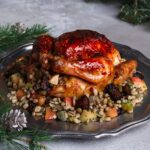
Fig Glazed Cornish Hens with Barley Stuffing
Servings: 4 servings
Ingredients
- 4 whole Cornish game hens
- kosher salt as needed
Barley Stuffing
- 1 cup (190 g) pearl barley
- 2 cups (500 ml) chicken broth
- 2 tbsp (14 g) butter
- 1 onion diced
- 3 stalks celery diced
- 1 apple cored and diced
- 1 cup (180 g) dried figs diced
- 2 tbsp (30 ml) chopped fresh sage
- 2 tbsp (30 ml) chopped fresh parsley
- ½ tsp (3 g) kosher salt
Fig Glazed Cornish Hens
- 2 tbsp (30 ml) olive oil plus extra as needed
- 1 small onion thickly sliced
- 2 stalks celery cut into 3 or 4 pieces each
- 3 whole garlic cloves unpeeled
- 6-7 whole dried figs
- 3 sprigs fresh sage
- 4 sprigs fresh rosemary divided
- 3 tbsp (21 g) butter
- ½ cup (125 ml) fig preserves or jam
- 2 tsp (10 ml) balsamic vinegar
- 1 tsp (5 ml) lemon juice
- ½ tsp (3 g) kosher salt plus extra
- ¼ tsp (1.5 g) pepper
- 2 cups (500 ml) chicken broth
- 1 ½ tsp (4 g) cornstarch
- 2 tsp (10 ml) water
Instructions
- If desired, salt the hens overnight. Pat the hens dry. Liberally sprinkle kosher salt all over the surface of the hens, even on the back. Place the hens on a plate and cover. Refrigerate overnight.
- Remove the hens from the fridge an hour before you intend to roast them. Remove any covering and pat the hens dry. Allow to come up to room temperature uncovered to allow the skin to dry off.
Barley Stuffing
- Place the barley in a strainer and rinse with cold water. Transfer the barley to a saucepan along with the chicken broth. Cover and bring to a boil. When the broth comes to a boil, turn the heat down to low and cook until the barley is tender – about 45 minutes.
- In a skillet, melt the butter over medium low heat. Add the onion and celery and sauté until tender – about 5 to 7 minutes. Add the diced apple and sauté for a couple of minutes until the apple begins to soften. Add the diced figs and cook for another couple of minutes until the apple is tender.
- When the barley is cooked, add to the skillet along with the chopped fresh sage, chopped fresh parsley, and kosher salt. Mix together well, taste, and adjust the seasoning if needed. Set aside until ready to stuff the hens.
Fig Glazed Cornish Hens
- Preheat the oven to 400°F. Drizzle a large roasting pan with 2 tablespoons olive oil. Scatter in the sliced onion, celery stalks, garlic cloves, dried figs, fresh sage and 3 sprigs fresh rosemary. Place a rack on top of the aromatics.
- To stuff the hens, transfer some of the stuffing into a separate bowl so that any contact from the spoon used to stuff the raw hens doesn't come into contact with the remaining stuffing. This will prevent cross-contamination if not all of the stuffing is used. Use a spoon to fill the cavity of each hen, packing lightly. Use twine to tie the legs together and tuck the wing tips under each hen. Transfer any remaining barley stuffing to a small baking dish and cover with foil.
- Arrange the hens in the roasting pan with the legs positioned towards the outer edge of the pan and the breasts in the middle. Rub each hen with olive oil and season with kosher salt. Roast the hens for 1 hour 15 minutes to 1 hour 45 minutes, depending on size. While the hens are roasting, prepare the fig glaze. Begin glazing the hens when they reach an internal temperature of around 145°F in the breast and thickest part of the leg. At this point, bake the remaining pearl barley stuffing just until it's heated through.
- Melt the butter in a small saucepan over medium heat. Add the fig preserves along with the lemon juice, balsamic vinegar, kosher salt and pepper. Allow the preserves to melt and then whisk together. Add the remaining rosemary sprig and let cook for another minute. Remove from the heat and let steep until ready to use. If the glaze thickens after cooling, simply reheat before using.
- When the hens reach an internal temperature of around 145°F in the breast and thickest part of the leg, begin the glazing process. Set aside 2 tablespoon of the glaze and reserve for the pan sauce. Brush each hen generously with the glaze. Return the hens to the oven and roast for another 10 minutes. Repeat once or twice until all the glaze has been used. Continue roasting until the hens are fully cooked.
- If the hens start to become dark before they're done, cover them loosely with foil and continue roasting. The hens are done when they reach an internal temperature of 165°F in the breast and thickest part of the leg. Check that any juices from inside the cavity run clear.
- Transfer the roasted hens to a serving platter and cover with foil to keep warm. Remove the aromatics from the roasting pan and skim any fat from the pan juices. Place the roasting pan over medium heat and add the chicken broth. Bring to a boil and let simmer until the liquid reduces to about 1 ½ cups.
- Combine the cornstarch and water in a small cup to make a slurry. Whisk the slurry into the pan juices and cook until thickened. Add the reserved 2 tablespoon of fig glaze and whisk together. Taste the sauce and adjust the seasoning with more kosher salt if needed. Strain the pan sauce through a fine mesh strainer and keep warm.
- To serve, remove the twine from the hens. You can serve the hens whole or carve them into quarters. To quarter, remove each leg from the hen, keeping the thigh and drumstick together. Then remove each breast, with or without the wing attached. Scoop the stuffing out from the cavity and serve alongside the hens. Serve with the remaining stuffing and pan sauce. Enjoy!
